Blog Posts
Occasional musings on a range of themes…

Mind the Gap!
It is the encounter between socially engaged musicians and their various publics – rather than the institutionalised approach per se – which holds the promise of a more democratic participation in cultural life.
My copy of Community Music at the Boundaries arrived just in time for the virtual book launch live from Canada today. This new publication edited by Dr. Lee Willingham at the Laurier Centre Centre for Community Music in Ontario contains an exciting range of contemporary writers on the subject of Community Music as a practice of ‘boundary walking’, including a chapter of mine entitled ‘Mind the Gap!’ exploring how the widening gap between the haves and the have nots when it comes to cultural resources can at least be partly addressed by bridging the gap between HE study and the real world. Even though I wrote the chapter a couple of years ago as I was leaving Sage Gateshead, its publication is timely at a time when the UK government are seeking to cut resources for Arts in HE, widening both of these gaps still further.
In the chapter, I question whether cultural institutions are the best placed to address the widening gaps in cultural participation:
As institutions represent the most distinguished forms of capital of the ‘rational community’ of culture, developing more democratic forms of cultural engagement requires them to ‘break’ (Bourdieu et al., 1991) from their own world view to encourage the dissensual voices of the ‘community of those who have nothing in common’ (Lingis, 1994) to contribute to cultural discourse and policy. Either that, or such development has to take place outside of the institution altogether.
Furthermore, in terms of social justice and cultural democracy, it’s the individual rather than the institution which is the site of transformation:
it is the encounter between socially engaged musicians and their various publics – rather than the institutionalised approach per se – which holds the promise of a more democratic participation in cultural life.
All of which points to the need for…
a shift in cultural policy, to provide more opportunities for individual and groups of artists to bring about the changes in access to cultural participation which are needed to enable every citizen to lead a creative and fulfilling life
As part of the research for the chapter, I’d coordinated a survey of the Jazz and Community Music graduates of the undergraduate programmes at Sage Gateshead, to better understand how this musical community of practice in the NE of the UK contributes to the cultural life of the region. One of the striking things is how important teaching and facilitation are within these musicians’ professional portfolios:
while the relationship between time spent on different musical activities and income derived from those activities is roughly equal in most cases, for teaching it is significantly higher (47% of income for 34% of activity), suggesting that for these musicians, teaching is an effective means of stabilizing income across a broad portfolio of professional work
I’m old enough to remember the 1980s when the onset of neoliberalism started to remove the safety nets which had prevented people falling into poverty or deprivation. Even then, as public resources for the Arts dwindled, artists of all disciplines simply found different ways of engaging publics in creative and imaginative ways. For the most part, grass roots practices have survived through the sheer determination and passion of artists to make a difference in the world, with or without government support. Of course we can achieve more if we have the support of public funds, but even without it, socially engaged artists will always commit to working in the gaps and the cracks as part of a commitment to the potential of the Arts to transform people’s lives. Apart from anything else, it’s in the gaps and the cracks that new seeds can take root and start to grow.
This chapter is the first piece in a jigsaw of publications I’ve got coming out this year, establishing the ground for my forthcoming publication Music Making and the Civic Imagination, due in 2022. You can get a copy of the book from all good booksellers including Amazon, and the launch event today is a public event on Zoom so you can find out more from some of the other authors involved.
p.s. the photo is of the book sitting on top of new toy for the Communitas project this summer which arrived yesterday, the awesome Ambox!

One World Fellowship
Perhaps now more than ever in the post-war period, we need ways of seeing past the things which divide us as a species, in order to reveal our common humanity. Singing in a group is one of those ways. It’s a universal experience – all humans do it, and always have done, as a way of building bonds of trust and mutuality.
Remembrance
I spent the 2-minute silence for the 100th anniversary of the armistice of the Great War 2014-18 on top of Great Gable surrounded by hundreds of others who had gathered for the same purpose, demonstrating our solidarity with those who had ‘surrendered their part in the fellowship of hill and wind and sunshine’ during the Great War 1914-18, ‘that the freedom of this land, the freedom of our spirit should endure’ (Winthrop-Young 1924). It was a powerful moment, the silence of so many people, lashed by the fierce gusts on Windy Gap, and cold November rain on the summit, standing together to honour the memory of people most of us had never met, but whose act of collective sacrifice had set in motion the preservation of our right to freely walk the majestic landscape of the Cumbrian fells.
The cycle of remembrance continues. In September 2019, we’ll mark the 80th anniversary of the outbreak of the Second World War, and the further horrors which came with it. In this brief period in our history, the 10 months in between two such significant anniversaries, as well as honouring the memories of all those who sacrificed their lives for the benefit of future generations they would never meet, we can also think about what kind of world they were hoping their ultimate sacrifice would bring about. Surely, a world where families feel safe, where the threat of violence is kept at bay by the collective will never to have to repeat the same levels of destruction brought about by global violence. People were fighting ‘the war to end all wars.’
Fellowship of Hill and Wind and Sunshine
Remembrance is not a single event; it is a continuous process of honouring those who have died, whilst at the same time putting into action the values and ideals which they died for. Over the summer, the Fellowship of Hill and Wind and Sunshine project has brought together more than a hundred amateur singers to sing a special song cycle which simultaneously remembers those who died in the Great War, and also which enacts the ideal of freedom their sacrifice intended. These singers scaled and sang on the same Lake District fells given to the nation by the Fell and Rock Climbing Club (FRCC) to honour their members who died in the Great War.
The National Trust has today published a film on Youtube about our singing adventures this summer which captures the spirit of the project. I believe that what we discovered over the course of the Fellowship project is the same kind of solidarity and unity with each other and the land we walk on, which inspired those who ‘surrendered their part’ in it to want to preserve. It is a powerful feeling, the sense that we are enjoying a freedom which someone else – millions of people, in fact - paid for with their life. Part of our duty to the memory of those who died, is a call to live our own lives consistent with the values and ideals which inspired their sacrifice, their hope for a better world.
Our Common Humanity
Perhaps now more than ever in the European ‘post-war’ period, we need ways of seeing past the things which divide us as a species, in order to reveal our common humanity. Singing in a group is one of those ways. It’s a universal experience – all humans do it, and always have done, as a way of building bonds of trust and mutuality. It’s no surprise therefore that some of the most powerful stories to survive from the trenches are of those moments when both sides were able to use their singing voices to create harmony with each other, despite their day-to-day hostility toward each other. It’s a strong message about the power of singing to establish a connection not just to each other, and to ourselves, but to our common humanity. It’s been a joy and a privilege to witness this powerful effect of group singing on the many people who have joined us on the ‘Fellowship’ project. It’s felt like a genuine and potent way to honour the memories of the fallen, by engaging in the very acts of collective solidarity in the natural world which their sacrifices sought to preserve.
Legacy
The Fellowship project is concluding with a number of events this autumn to share its impact more widely. A ‘scratch’ choir has emerged from the project, drawn from the hundred or so people who sang on the mountains, and others who have been welcomed into the throng with a shared love of singing together. This ‘Fellowship Choir’ performed at the Lakes Alive festival in September, a special event in Keswick School in October, and this last weekend at Kendal Mountain Festival, as part of a moving presentation commemorating the ‘great gift’.
One World Fellowship - 15th Dec
The final concert this year will be on December 15th at Christchurch in Cockermouth with an evening concert of joyous harmony featuring many of the singers who have raised their voices this summer to demonstrate in the most vivid sense the freedom which so many people died for. We’ve called the concert ‘One World Fellowship’ to emphasise not just the historical importance of the ‘great gift’ by a group of Cumbrian mountaineers, but also to remember the dream of world peace which their comrades’ sacrifice was intended to deliver. I hope it will be a powerful and fitting way of marking the end of the project, and all proceeds from the event will go to Cumbria Scouts, to support their ambitions to take young people from Cumbria to the international Scouting Jamboree in the US next year, where the next generation of citizens can start to build their own global fellowship with other young people from around the world who share a belief in the power of peace, harmony and cooperation as essential values on our increasingly complex and fragile planet.
The copyright-free songs from the Fellowship project are freely available online, in the same spirit of ‘gift’ which underpins the inspirational gift of land by the FRCC. In its own small way, I hope the project provides one way of realising the dreams of freedom which motivated the actions of those who died in the Great War, living our lives in the same spirit of fellowship which underscored their great sacrifice.
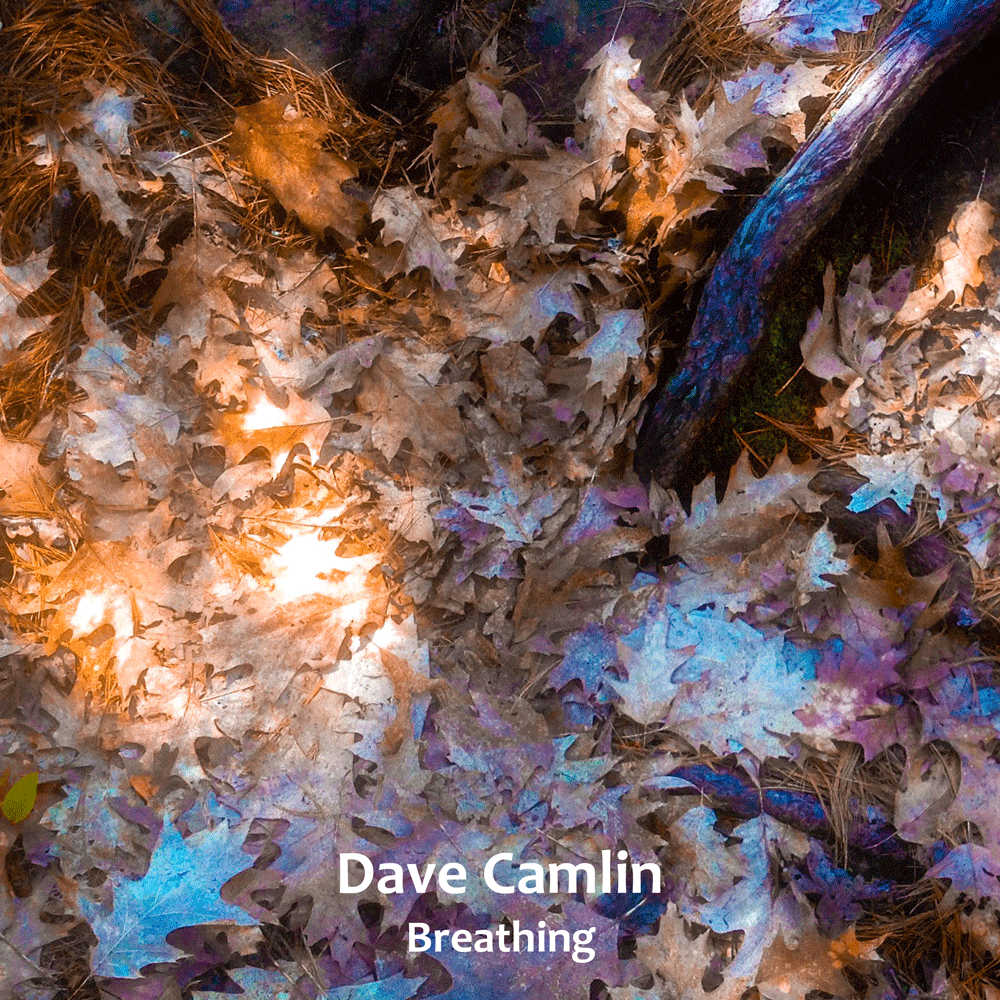
Breathing
First EP of laid-back jazzy songs off forthcoming album The Journey is The Destination.
I'm excited to announce that the first solo EP of laid-back jazzy acoustic tracks from last year's sessions at Loft Studios are now available to buy / stream on Spotify / iTunes and wherever you'd normally get your digital music from.
'Breathing' has three tracks on it that I'm mightily proud of, recorded 'live' at Loft in Newcastle by Adam Sinclair with a fantastic band:
- Bethany Elen Coyle (vocals)
- Bex Mather (vocals)
- Brendan Murphy (percussion)
- Dave Camlin (acoustic guitar, vocals)
- Paul Edis (piano, organ, woodwind)
- Paul Susans (bass, vocals)
- Russ Morgan (drums)
The first of three EPs from forthcoming album The Journey is the Destination, the vibe is downbeat and mellow, with lots of space to sink into the music like your favourite duvet.
Please listen, like and share!
- Breathing - the simple things in life, based around a Paul S chord progression, featuring Paul E on woodwind
- No-One Ever Goes There - getting away to the middle of nowhere, featuring Bren's iconic Sauvignon Blancophone, and the lush harmonies of Bethany, Bex and Paul S
- Say You Want Me - surviving the winter together, with Russ and Bren laying down a relaxed country shuffle
Collaborators..?
There are no videos for these songs yet - I'm looking for collaborators who feel inspired by any of the songs to respond to them in some way that we could capture on film - something you make? A dance? A piece of art? A favourite walk? Get in touch if you feel inspired...
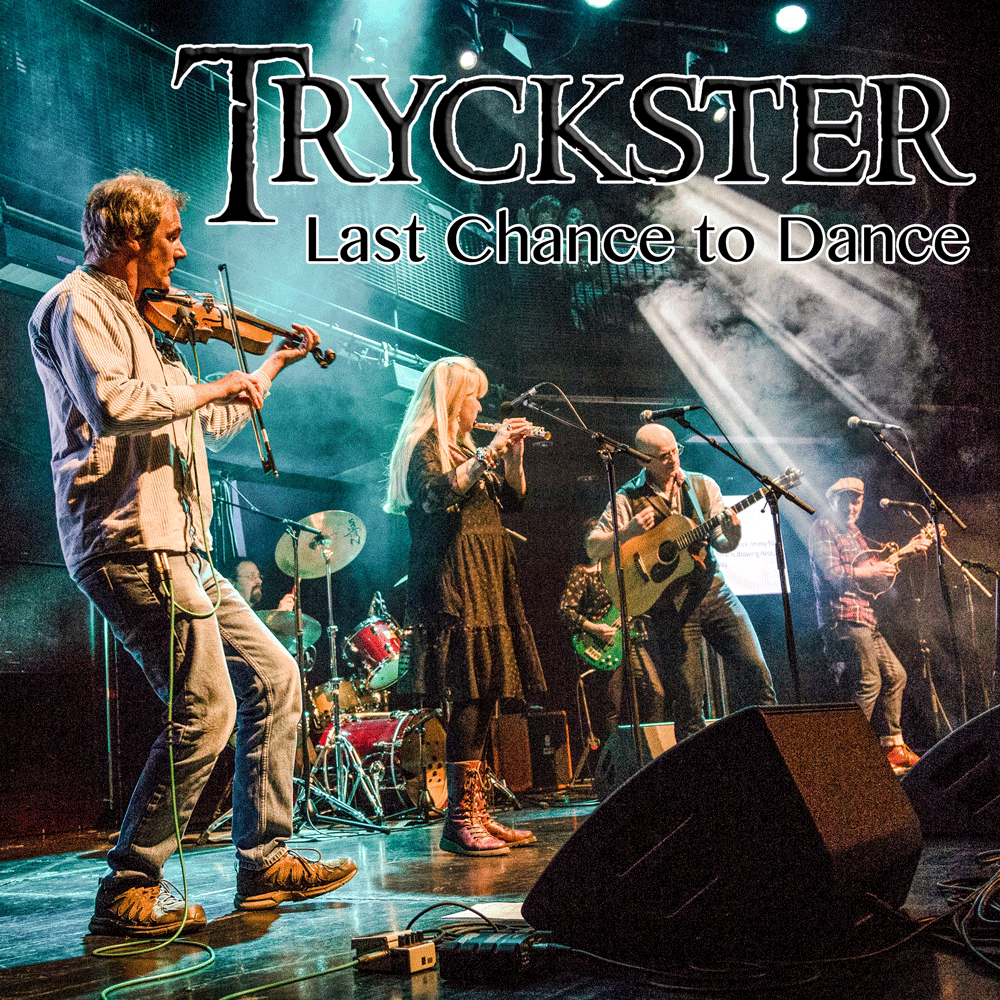
Last Chance to Dance
Last Chance to Dance is crafted with a toe-tapping nudge of anti-globalisation, anti-privatisation, anti-zero hours and pro-Corbyn message; their river of music has the rhythm of the earth in its boots.
A great 4-star review of the new Tryckster live album by Andrew Darlington in this month's Rock 'n' Reel:
"Tryckster dance untamed across your tongue in the most delicious mix trick-ology. A six-piece recorded live at the Coast to Coast event at the Sage, Gateshead in July 2017, yet with studio-quality sound as timeless as electricity can make it.
"A couple of songs from their 1999 When the Stone is Exposed are shoved into a live context, sans dialogue, including the powerfully anthemic ‘Old Straight Tracks’ – as solid as the Cumbrian Castlerigg Stone Circle, enhanced by community choir. Fiddle-driven, decked out with flute and mandolin, powered by Joanne Braniff’s bass and drummer Craig Hoggarth anchoring rhythms. New, and as hauntingly familiar as forever, as rooted as ‘Trees’, as agile as a sleight of hand, switching vocals in a swap-around game with gruff, forceful Dave Camlin in his current guise always to the fore.
"Raucous, thanks to the beer and a headful of stars, yet finely lathe-turned, Last Chance to Dance is crafted with a toe-tapping nudge of anti-globalisation, anti-privatisation, anti-zero hours and pro-Corbyn message; their river of music has the rhythm of the earth in its boots. I’ve a feeling there’ll be more dance to come."
The album is available to buy from us at gigs, or on Spotify.
More about Tryckster at www.tryckster.com
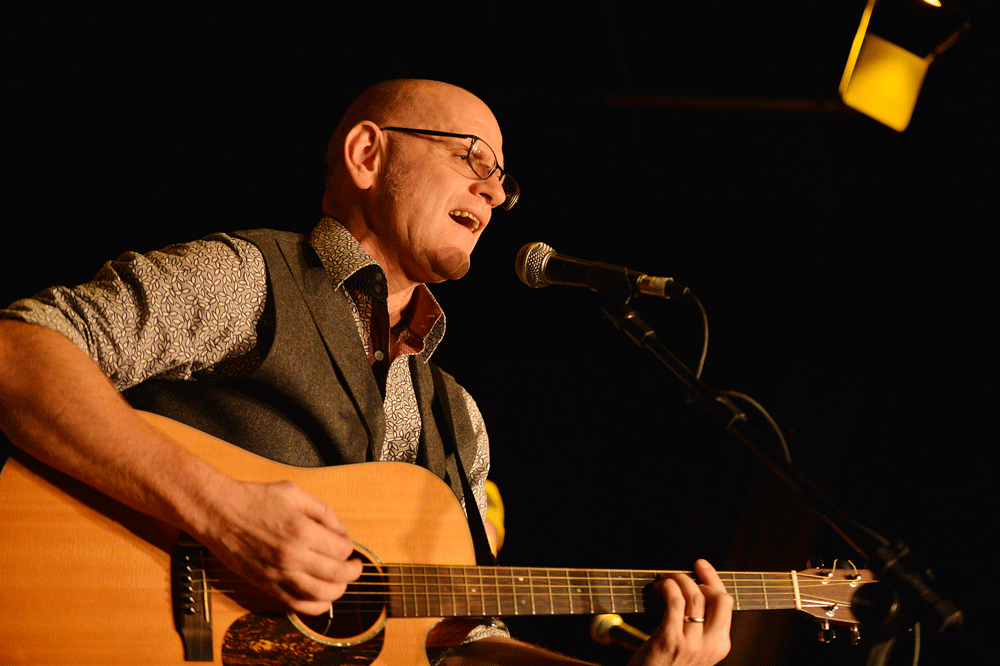
Tonight Matthew...
Linus Paul famously said, “the best way to have a good idea is to have a lot of ideas.” The same applies with song-writing: the best way to write a good song is to write more songs. But new songs need somewhere to be heard...
A while ago now, I wrote a song - Tonight Matthew – railing against the rise of so-called ‘Reality TV’ music – the X-Factors and talent shows of light entertainment, spawned by their more innocent ancestors like ‘Stars in Their Eyes’ and ‘Opportunity Knocks’. For someone who’s also felt the urge to write and sing their own songs, resisting the pressure in live performance to ‘sing something we know’ has been a feature of my entire adult career as a musician.
It’s not always easy – writing a good song means finding the right balance between familiarity and novelty; familiar enough for an audience to latch on to some of the musical elements, but ideally saying something that’s not been said before, or not said in that way before.
I cut my song-writing teeth in the Cottage By The Brook Folk Club in Stafford where I was a student. I made a point of bringing a new song to the club every week, and I relished the challenge of coming back each week with a new offering. Most of those songs weren’t that great, to be honest - although a few have survived – but that’s not the point. What mattered was having somewhere to be able to take new songs to where you knew they’d be listened to, and where you could hear other people’s song-writing skills develop too. The instant feedback of audience response is a great barometer for knowing how your songs are working.
Linus Paul famously said, “the best way to have a good idea is to have a lot of ideas.” The same applies with song-writing: the best way to write a good song is to write more songs. But new songs need somewhere to be heard. When I play Tonight Matthew live nowadays, I also use it as a way of thanking the audience for turning up to listen to live original music. It’s so much easier to stay at home and glue yourself to a screen these days, rather than venturing out of the door to be part of any local celebration of everyday creativity. Keeping live music alive needs people – audiences, performers, sometimes both – to come together in the magical little spaces where creativity still thrives.
So I’m thrilled to be co-hosting the first Secret Chord Song-Writers’ Circle with fellow local song-writer Paul O’Halloran (of the Black Guards) at Florence Arts centre in my old stamping ground of Egremont in west Cumbria this weekend. I’m hoping that a few new faces will appear, song books in hand, to test out their latest ‘beginnings’ in front of an appreciative crowd. And I hope that the event draws an appreciative crowd away from the gogglebox and into the magical surroundings of Florence Arts Centre, a former mine and now a thriving hub of local creativity.
I also hope I’d have had the courage as someone at the start of their song-writing journey to get up and sing one of my hard-won creations – although I fear that my earliest outpourings like Nigel My Parrot and Police Country Gentleman will never see the light of day again. And that’s probably for the best.
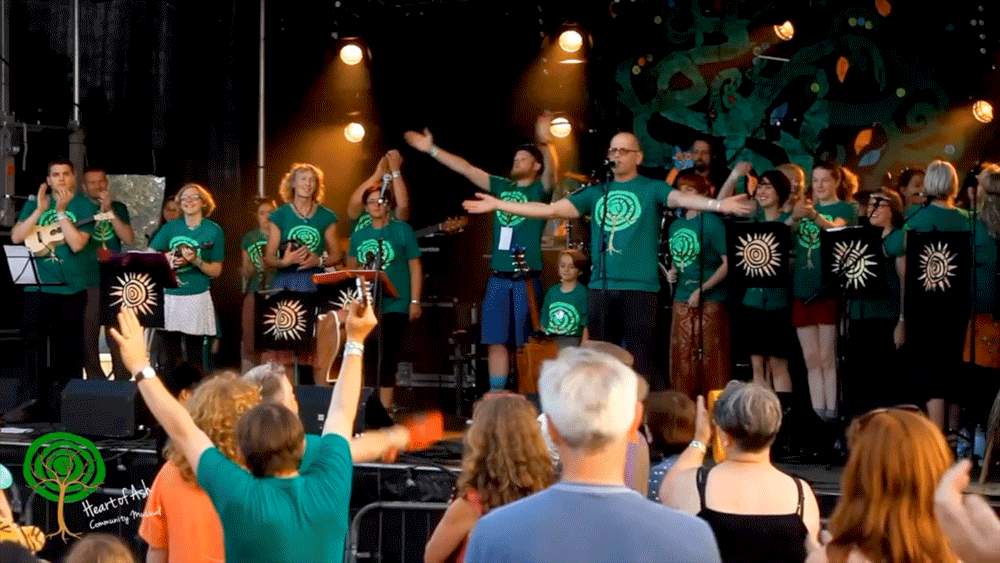
Heart of Ash
Celebratory videos from the 2013 Solfest Community Musical: Heart of Ash
Recently I was looking for the videos of one of the Solfest community musicals online, and after a bit of fruitless searching, I realized that I’d never posted them. So here they are!
These videos are from the 2013 event Heart of Ash, featuring an all-star cast. Dan Serridge stepped in at the last minute as the story-teller to cover for someone who was suddenly indisposed, and did a brilliant job.
The house band had Paul Susans (bass), Rachel Cross (fiddle), Bren Murphy & Sarah Fisher (percussion), Joe Johnstone (ukulele, vox), and Barry Crosby / Craig Hoggarth (drums) in it, with a ‘scratch’ band and choir of festival-goers. Sing Owt! was the main choir, with Bex Mather and a whole bunch of students from the Sage Gateshead degree programmes lending us their voices, and a guest appearance at the end from the mighty Boom Dang! The students ran instrumental (inc. ukulele) and vocal workshops throughout the weekend for festival-goers, and a good crowd of workshop attendees joined us for the finale, a rousing Heel and Toe Polka!
The theme of the 2013 community musical was the plight of the Ash tree, as this was around the time that the news of Ash ‘Die-back’ was breaking, and there were concerns that the Ash tree’s days were numbered. Especially as Aspatria (or Ash Patrick i.e. Patrick’s Ash) is the nearest town, it felt fitting to celebrate this great British tree. I’m relieved that in 2017 the Ash trees in our garden are still going strong!
Apologies to everyone involved for the inordinate amount of time it’s taken to post these! As I trawl through old footage there may be more to come from the archives, but for now, I hope you enjoy these offerings. Click here for the full Heart of Ash playlist, or below for individual videos:
· Place Where You Earned Your Name – Simon Kay’s marvelous Solfest anthem
· Reap What You Sow – a song about Karma and justice
· Elesa – a song from Georgia about bringing trees from the forest
· The Ash Grove – trad. Folk song about Ash
· Bop Your Bippity Boo! – a catchy little round that fits nicely with Miss McLeod’s reel as an accompaniment to the Heel and Toe Polka
Thanks to everyone involved! Happy Days!

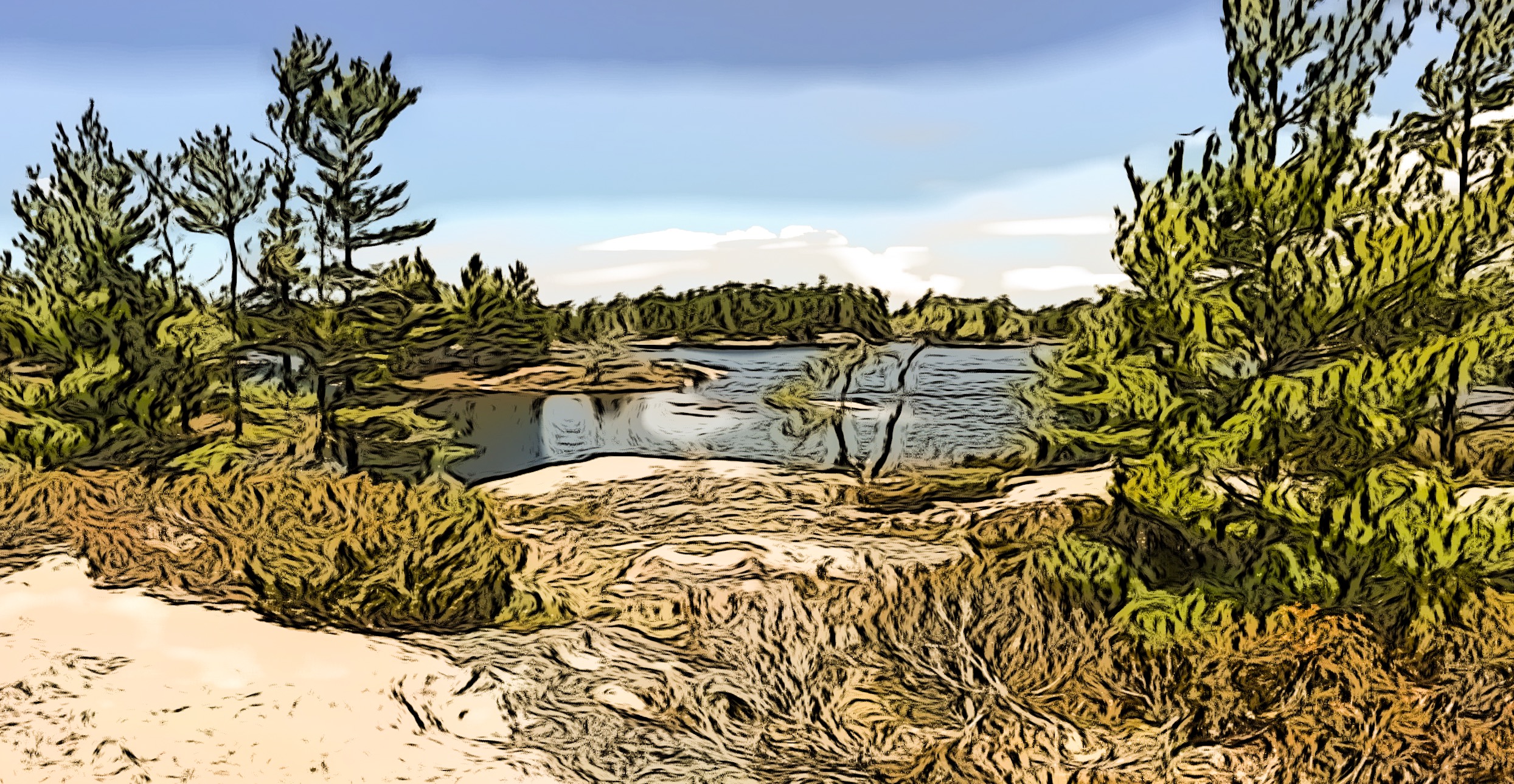
Postcard from Beausoleil
The island is just awakening from its annual slumber, the green fuse of spring igniting and exploding through the crust of fallen leaves. The wind is strong, and the views of Georgian Bay and the start of the 30,000 Islands are awesome and inspiring.
Having the whole day to get from Waterloo in western Ontario back to Toronto for my evening flight back to the UK, I decide to drive North for the afternoon to seek some wilderness. The intense discourse of the Community Music (CM) conference at Wilfrid Laurier university has moved me, raising some difficult and challenging questions for me, and I need to connect with some earth.
All my life I’ve lived with the presence of the Cumbrian landscape in my blood and my bones, and since 2008 on my arm in the form of a tattoo of the cup and ring markings found on the Little Meg stone near Penrith. Like The Levellers, ‘I like to walk in ancient places – these are things that I can understand.’ However, the culture of our Neolithic forebears is not a ‘living’ tradition – it has been lost, re-invented, re-imagined and re-claimed by all those who draw inspiration from the enduring legacy of the monuments they left behind.
All that is certain is that – like us - our ancestors must also have stood and been amazed by the power of the ancient stones that litter our European shores. I’ve always found a comfort in knowing that I’m just one of a series of humans over many centuries to be inspired by our stone circles and ancient places. The mystery of not really knowing what meaning my ancestors ascribed to these monuments gives me permission to make my own meaning of them.
So it stabs me through the heart to be confronted by the reality of the indigenous experience at the CM conference, which I’ve obviously always known about, or thought I did. There’s certainly a sadness for me in acknowledging that the wisdom of my Celtic ancestors - who built the Neolithic monuments in Europe that have been so much a part of my own identity - has been suppressed and oppressed by more dominant ‘incoming’ – or invading - cultures. But this sadness pales starkly at the realisation that this hegemonic process of cultural imperialism is a living reality for so many people across the planet. Right now.
I feel like I’ve been living my life in a bubble, free to use my position of privilege to make my own cultural meaning of my surroundings, while the ancient living wisdom of many cultures is torn apart and cruelly destroyed, through inhuman processes like the ‘residential schools’ in Canada where indigenous children were taken to be separated from their parents, to cut the vital cord between them and their ancestors, their culture, their land. The generational hurt is overwhelmingly horrific – it literally makes me feel sick.
The rift that I feel between my experience of the land, and that of my ancestors, is a nostalgic longing for something that can never be; the oral wisdom passed down from generation to generation was snuffed out centuries ago. The rift that is happening right now for generations of indigenous people across the planet is a real and brutal severing of the cultural equivalent of their spinal cord, leaving a raw wound in place of thousands of years of cultural knowledge. Many of the stories I’ve heard this week bear testimony to this most cruel of assaults.
On the flight over to Canada, I listened to a great interview with Jared Diamond, who was talking about his recent book which discusses – among other things - that there are still some indigenous peoples on the planet – mainly in New Guinea and the Amazon basin - who have not yet had ‘first contact’ with ‘white people’. As we become a global society, how do we protect the ancient wisdom of these, our most adapted citizens, who have learned over millennia how to live with the resources of the earth rather than exploit them?
My response to the feelings of shame, guilt and sorrow that I felt at my brief exposure to the experience of the indigenous people of Canada is the same as I usually respond to those feelings – a compulsion to be somewhere remote and to make music, to honour the earth and to humbly offer my imperfect outpourings of song as a way of expressing my commitment to living better and more honourably. To live up to the promise I made to the gods my people swear by to do so. To know that the spirit in me, and the spirit in the land, is the same spirit.
And that’s how I came to be making a ‘singing postcard from nowhere’ on Beausoleil Island in Georgian Bay. Dave, the water taxi driver who ferried me over, told me I was the first person he’d taken onto Beausoleil this year, and I encountered no-one during the few hours I was there. The island is just awakening from its annual slumber, the green fuse of spring igniting and exploding through the crust of fallen leaves. The wind is strong, and the views of Georgian Bay and the start of the 30,000 Islands are awesome and inspiring.
I see few signs of life – a flash of white in the undergrowth once, quickly vanishing. Fortunately none of the rattlesnakes which live on the Georgian Bay islands. As I crash through the undergrowth surrounding Fairy Lake in the north part of the island, I feel reasonably confident that any native wildlife would have heard me coming a long time before they could see me, and headed elsewhere.
However, there is a flock of huge birds which rise and circle over me while I sing in Frying Pan Bay, and I am suddenly reminded of two stories I’ve heard this week. Darren Thomas (his ‘English;’ name), the elder whose powerful and challenging welcome to the indigenous lands the university is built on, tells us that the smudging ceremony he leads us through is partly to do with cleansing us of any ill intent we bring with us, but also partly a way of asking ‘who are you and what do you want here’?
My colleague and friend Brydie Leigh-Bartleet recounts another tale; a beautiful story of sitting out under the night sky with her indigenous Australian mentor, watching birds circle overhead and being told that they are spirits, the ancestors curiously investigating this stranger in their midst. I realise with a shock that the birds of Beausoleil Island are checking me out; they want to know who I am and what do I want here?
And so I sing, because it’s the only way I have of demonstrating that I bring no evil intent with me. And my song is of my land, far away; the quiet places like this where no-one ever goes, the simple act of breathing on the earth, and the sacred union we make when we sing together in its bounty. As I sing, the birds settle back down into the trees. Nothing to see here; no threat.
When I sing in and with the land, wherever I am, I know who I am. It is a primal connection which never fails to soothe my insecurities and my fears. They are songs that I’ve made up, because I have none that have been passed down to me from ancestors thousands of years distant. Their words and songs only exist now in the natural world which inspired them, and which continue to inspire me.
But the song is the same song – the one that celebrates our inhabitation of this place, this amazing earth, this beautiful land. This invented ancestry which gives me succour throws the damage wrought upon indigenous people into stark relief. Theirs is a living tradition, a bloodline of culture unbroken for thousands of years. It is perhaps our greatest treasure and highest achievement as a species. The reality of the destruction of indigenous culture across the globe is a hurt which we all must feel. It is an assault on all of us, and we all have an obligation to do something about it.
Walking the Boundaries, Bridging the Gaps
"If there ever is going to be healing, first there has to remembering, and then grieving, so that there then can be forgiving. There has to be knowledge and understanding." (Sinead O'Connor 1994)
This week, I’ve been privileged to have been given the opportunity to attend the first international Community Music conference in North America, at Wilfrid Laurier university in Waterloo, Ontario. I’ve been presenting papers on my ‘Music In Three Dimensions’ model as well as preliminary findings of our research into the ‘portfolio’ musical careers that have emerged around the community of practice of Sage Gateshead (with Ian Paterson and Ryan Humphrey joining me via Skype). The level of engagement and discourse around Community Music has been deep and intense, and I’m sure I’m not the only delegate to be leaving feeling changed by the experience.
Conceived and engineered by the remarkable Professor Lee Willingham and his inspiring team of musicians, managers, students and volunteers, the conference has been a profound encounter, leaving me full of questions, doubts, confusion, sorrow and hope in equal measure. The conference was entitled ‘Walking the Boundaries, Bridging The Gaps’, highlighting the role that music might have in healing some of the damage wrought on the indigenous people of Canada over centuries of settlement. It’s a sensitive and complex issue etched into the lives, histories and countenances of many people that I’ve met here, and one that I really don’t feel qualified to discuss.
And yet, to be silent on the subject is to add my voice to the tacit consensus that this is a matter of history, something that happened in the past that has been resolved through the Canadian truth and reconciliation commission which reported a few years ago. It’s clear to me from my brief and intense exposure to the rawness and strength of feeling here that this is not just a painful scar from the past, and yet it is also more than the vivid wound still raw in the present. How the indigenous people of (what I’m used to calling) Canada find peace, and maintain their ancient relationship with the land in a world utterly transformed by the exploitation of it – and them - is a question that concerns all of us, and all our futures.
If music can help here, it can surely help anywhere. Hearing the stories and songs of the people here – indigenous and ‘settler’ alike – does give hope. Witnessing the power and solidarity of Mino Ode Kwewak N’gamowak (Goodhearted Women Singers) led by Kelly Laurila, and the fiery passion of Glenn Marais, leaves one in no doubt that music can speak where words alone would fail. Despite the damage wrought upon indigenous people in Canada, their singing voices bear testimony to that injustice, but also to the abiding strength which maintains their sacred connection to themselves, each other, and the land itself.
I’m reminded of Sinead O’Connor’s powerful lyrics about the Irish peace process, where she sang, ‘if there ever is going to be healing, first there has to remembering, and then grieving, so that there then can be forgiving. There has to be knowledge and understanding.’ That music may play some small part in the process, in how the people in this fractured and complex story find a resolution, is a call to action for musicians everywhere. What is learned from the musical journeys of those navigating truth and reconciliation processes across the globe give us profound insights into the kind of future we can dream of, where the sacred right to be human on this earth can be enacted in harmony with each other and the earth, in song and in fellowship.

Thoughts from São Paulo
Participation in active music-making can be a way of enacting human rights which individuals or groups of people might be otherwise deprived of, including the right to be ‘free and equal in dignity’, to experience a ‘spirit of brotherhood’, to be part of a ‘family’, and to enjoy ‘rest and leisure’ (United Nations 1948).
This week, I’ve been in Brazil on a week’s residency with Mouthful, working toward a collaborative performance at Museu de Arte de São Paulo (MASP) with the youth choir of Guri Santa Marcelina, an inspirational music organization based in the city. We’ve been joined for the week by Rico, Jan and Marcela (and also Pablo for some of the week) from the People’s Palace Projects (PPP) in Rio, whose work with homeless people has introduced another depth to our residency, bringing the real value of music more sharply into focus, and inviting all of us to think more deeply about why we do what we do.
All of the PPP delegation are a genuinely inspirational bunch: articulate, funny, passionate and committed. And yet two of their number, Rico and Marcela, have as little English as I have Portuguese, making conventional dialogue a bit redundant, and ultimately strained. For me, it’s only been last night, when we’ve all sat around in our hotel bar with a guitar - and more caiprinhas than a medical doctor would consider to fall within the boundaries of common sense - that we’ve finally been able to communicate more clearly with each other. Radiohead songs (Pablo Honey era of course), Queen mash-ups and traditional Brazilian popular songs, alongside our own compositions have been the currency. Through this musical sharing and collaboration, we’ve all been given an insight into each other’s internal emotional lives, building a strong sense of intimacy and trust. As we add harmonies and rhythms to each other’s songs, we acknowledge the truths that are being shared, and validate them. As Stephen Mithen suggests (Mithen 2007, pp.47–50), music is a means of communicating emotions, especially when our means of communicating information falls short.
This simple truth about music is powerful. Reflecting on some of the dialogue that has gone on this week, it strengthens my belief that, for those deprived of what we might think of as basic human rights, group music-making can be a powerful act of what Ranciere might call ‘dissensus’ - a way of enacting some of those same rights which the nature of their relationship with society deprives them of. As well as the more obvious human right ‘freely to participate in the cultural life of the community, to enjoy the arts’ (United Nations 1948), participation in active music-making can also be a way of enacting human rights which individuals or groups of people might be otherwise deprived of, including the right to be ‘free and equal in dignity’, to experience a ‘spirit of brotherhood’, to be part of a ‘family’, and to enjoy ‘rest and leisure’ (ibid).
One might say that making music together - as something our species has done for the 60,000 or so years of our shared history (Mithen 2007; Dunbar 2012) – is one of the things that defines us as humans. Especially when other human rights are eroded, group music-making enables us to literally ‘sing the rights we do not possess’ (Camlin 2017) by participating in those rights simultaneously denied to us. In a choir, each voice contributes to the group sound and is therefore important. Each voice also needs to be balanced in relation to all the other voices – in volume, tone and articulation - in order to make a good collective sound. In this way, group singing can become an act of dissensus, a way of enacting those human rights outlined above which may be denied in everyday life.
The work that Rico, Jan and Marcela do is vital because even though a homeless person’s daily experience may exclude a sense of belonging to a collective whole (society) - which is fundamental to wellbeing and enshrined as a human right - in a choir such a sense of belonging can be realised. Group singing literally enables those participating in it to move closer to their ‘ontological and historical vocation to be more fully human.’ (Freire 1970, p.37)
As our residency at Guri draws to its conclusion, I’m reminded of what the real potency of music is; the deep interpersonal connections which music-making facilitates are truly emancipatory. The concert this afternoon is sure to be amazing and powerful, but will be even more so because of the human relationships which have been fostered and nurtured this week through our making music together.
References
Camlin, D.A. (2017). Singing The Rights We Do Not Possess. In: Community Music: beitrage zur Theorie und Praxis aus internationaler und desutshcer Perspektive. Munich: Waxmann, pp. 137–148.
Dunbar, R. (2012). On the Evolutionary Function of Song and Dance. In: N. Bannon (ed.). Music, Language and Human Evolution. OUP Oxford, pp. 201–214.
Freire, P. (1970). Pedagogy of the Oppressed. 2Rev Ed. London: Penguin.
Mithen, S. (2007). The Singing Neanderthals: The Origins of Music, Language, Mind, and Body. Harvard University Press.
United Nations (1948). Universal Declaration of Human Rights. [Online]. 1948. Available from: http://www.un.org/en/universal-declaration-human-rights/. [Accessed: 20 April 2017].

When in Munich...
Reflections on a workshop / seminar with an eclectic and emerging group of experienced Community Music practitioners, cultural workers, activists and academics in Munich...
I was delighted to have been invited over to Munich at the weekend to give a workshop / seminar for Community Music Muenchen, the emerging group of practitioners, cultural workers, activists and academics which Alicia Banffy initiated as part of her doctoral Action Research into the CM community in Munich. I first met some of the group in 2015, when I gave a paper at the academic conference that Alicia and Prof. Burkhard Hill had set up to discuss CM in Munich at Ludwig Maximillian University. In the time since the conference, they've both been incredibly hard at work turning some of the content of the conference into Germany’s first real academic text on Community Music. I'm very proud to have a chapter in it, where I suggest Ranciere’s conceptual frame of ‘dissensus’ as an antidote to the many failed attempts to define CM in more simple terms, based on my experiences in Caceres in southern Spain a few years, surrounded by flamenco dancers, singing nuns, and wildly expressive ‘idiot’ dancing. The chapter has obviously been translated into German for the book’s intended audience, but you can read an English translation here.
I loved giving the workshop, and can't thank Alicia, Kitty Von Korff, Marie Karaisal and Matthias Fischer enough for the opportunity to bring my ideas and my practice to the rather excellent assemblage of musicians, music therapists, social workers, teachers and students who attended. It's quite remarkable how much traction Alicia has managed to get with CM in Munich that in a matter of a few short months there could such an enthusiastic and talented group of 35 or so practitioners, all keen to develop their skills and knowledge.
It felt really appropriate that I was able to deliver the day as a ‘praxis’, combining my ‘music in three dimensions’ theory with a practical exploration of it as a walking meditation, and also exploring the ‘pillars of groove’ approach I use for facilitating participatory improvisation. On the flight over, I'd read Alexandra Kertz-Welzel’s rather fierce critique of CM in the Philosophy of Music Education Review, and was drafting a response, although some of the points she makes are, I think, quite valid. Unless musicians who practice CM are prepared and willing to develop their practice into praxis through study, we face two significant risks as a field. One is that we lay ourselves open to accusations of ‘anti-intellectualism’ which doesn't help us occupy a position of strength within the academy, which is where we need to be if we are to influence and inform the knowledge capital of music and music education. Secondly, it means vacating such positions to academic researchers at one (or more) step/s removed from the field of practice, which will in turn lead to more rigid boundaries between theory and practice, and a diminution of the voices and experiences of practitioners in knowledge terms. And we don't want that, do we?
Reflecting on one’s practice is essential to keeping it fresh, and I came away from the weekend feeling very confident that the dialogues we had started together would make a positive contribution to everyone’s praxis, mine included. Understanding what CM means in cultural terms in Germany is an excellent way of reflecting on what it means for me in the UK. It also really reminded me that CM is a truly international movement, whose membership is growing, broadening and strengthening all the time. Lee Higgins from the International Centre for Community Music was also at the book launch, and really helped to contextualise the German experience in the context of CM’s burgeoning presence world-wide. The eagerly-anticipated OUP Handbook of Community Music (which Katherine Zeserson and I also have a chapter in) is due out later this year, and its publication will be a timely marker of the growth of the CM movement across the globe.
I’m glad to be back on Northern soil now, but much refreshed by my trip to Munich, and the excellent and inspiring community of people there who made me so welcome. Thank you x

A New Lexicon?
how do we actually know the value of music? Is the experience generated through our senses enough? How arts and culture are experienced may be essential to understanding their value, but is it sufficient? I suggest not.
A long day at the start of a long and exciting week, but a privilege to be involved in the Community Music symposium at Leeds College of Music today that Christine Bates had organized. A really good spread of delegates from CM practice, research, local Arts officers, mental health workers, graduates and academics. Thanks for inviting me, Chris!
I came away from today with lots of useful insights, and a realisation that maybe part of the reason we seem to have variations of the same debate over the years is that we’re still evolving a new lexicon to discuss the new world we find ourselves in. Allowing ourselves to be drawn back into dichotomous thinking about ‘excellence’ vs. ‘access’, or the familiar thorny questions about ‘quality’ keep us mired in the same conceptual territory we need to shake off if we’re to escape the gravitational pull of the ways of thinking about cultural value that have shaped our history. How can we talk about being a musician without falling into the seemingly irresolvable tension between ‘performer’ and ‘teacher’ identity? The distinction matters less and less in practice, yet our language hasn’t kept up with these changes, meaning that when we try to talk about it, we simply don’t have the words.
I’d been invited to give a short provocation (presentation slides available here) and this a loose approximation of what I (think I) said...
The theme I’d been asked to respond to was, ‘the specific personal benefit of musical engagement’. In other words, how do we actually know the value of music? Is the experience generated through our senses enough? How arts and culture are experienced may be essential to understanding their value, but is it sufficient? I suggest not. Perceiving that something is good for us doesn’t mean that it is, hence the ‘placebo effect’. As Descartes observed, “[our] senses are deceptive, and it is wiser not to trust entirely to anything by which we have once been deceived” (Descartes 1641).
Yet most of our assumptions about the benefits of music seem to rely heavily on qualitative data – how people feel when we engage in it. However, if this were sufficient, then why is Music squeezed from the curriculum? Why are fewer students doing it at GCSE? Why aren’t Arts activities routinely prescribed over allopathic medicine? If music improves our mood, why can’t you get it easily from your doctor instead of medication?
The real problem seems to be that we can’t understand the benefit of arts and culture without understanding first how people experience it; a phenomenological understanding of experience is integral to cultural value. However, on its own, we have to face up to the unpalatable truth that a purely qualitative justification of arts and culture hasn’t been sufficiently compelling to make arts participation central to everyone’s lives. A more robust understanding of cultural value needs quantitative measures as well as qualitative ones; we need both.
Great progress is being made, albeit slowly. Daisy Fancourt et. al’s study from last year which demonstrated the positive psychobiological impact alongside people’s actual experiences of group singing springs to mind (Fancourt et al. 2016). Participants’ experience correlated with neuroendocrinal effects – genius!
But what if, in focusing on the individual, we may be considering the wrong unit of analysis?
“SIAP argue that focusing exclusively on how art and culture affect individual people might be a mistake. While we have growing evidence that individuals are changed through encounters with the arts, it could be that the full effect of arts cultural engagement can be captured only if one accounts for the relational and collective changes, ‘the ways in which the arts contribute to building community and linking different communities to one another’ (Stern and Seifert, 2013b, p.196 in (Crossick & Kaszynska 2016)).
What if the impact on ‘the group’ rather than the individual is what we should be measuring? How do we measure interpersonal benefit? Surely that’s impossible?
Maybe not. Scandinavian researchers have already demonstrated that ‘music structure determines heartrate variability (HRV) of singers’ (Vickhoff et al. 2013) suggesting that the collective entrainment that occurs during group music-making is something that is not beyond measurement.
For what it’s worth here’s my theory. It’s just a theory at the moment, as I don’t have the resources to be able to disprove it... One day, perhaps...
Borrowing from the emergent discipline of interpersonal neurobiology, I believe that active music-making facilitates wellbeing through the attunement of ‘resonance circuitry’ i.e. “mirror neuron system (MNS), the superior temporal cortex, the insula cortex, and the middle prefrontal cortex” (Siegel 2011, p.61) between people, manifest as synchronisation of respiratory function, HRV and brainwave emissions, among other measurable phenomena. Because music requires us to synchronise our internal state with that of other people, it acts sympathetically on this ‘resonance circuitry’, promoting a sense of collective wellbeing. As Dan Siegel says, [when ] “people realise – even on some subconscious level – that their state is being shared with another person’s state, in that recognition of the resonance, there’s this ‘feeling felt’ process that happens.” (Siegel 2015)
I’ve no plans to re-train to be a neurobiologist any time soon, but it shouldn’t stop me from wanting to understand what the neurobiological mechanism might be that’s engaged when people sing together. I might not be able to disprove this theory on my own – I’ll need the help of more scientifically-minded colleagues to do that – but it shouldn’t stop me trying, should it? Or at least being interested, as it means I can have more interesting discussions about it, which might lead somewhere I wasn’t expecting.
My provocation essentially amounts to this – if you could measure something about cultural experience, would you want to? And what would it be? And if the real benefit of cultural experience isn’t to be found in individual experience, but in collective experience, how would you measure that? And what new words would you need to describe it?

My Dream Job
"Decide what it is you enjoy doing most in the world. Then get someone to pay you to do it." (Tony Tindall)
“I am doing my dream job and fundamentally it is down to you.”
This is how a former student signed off an email to me this week, having been reminded of the rock band workshops they came to 13 years ago when they were still at school in Cockermouth. Since then, they’ve studied music tech at college and university, and gone on to become a Sound Engineer for the BBC's pop music stations (Radio 1, 1Xtra, Radio 2, 6 Music and Asian Network). It’s amazing and very humbling to get this kind of feedback, but it really drives home how fortunate we are if we can get to do what we love for a living.
Following the old adage of ‘choose a job you love, and you will never have to work a day in your life,’ my own careers advisor, a wonderful gentleman called Tony Tindall, gave me the only careers advice I’ve needed, or ever given. He told me, “it’s simple – decide what it is you enjoy doing most in the world. Then get someone to pay you to do it.”
Increasingly, we’re lucky if we get to do that, and automation of many jobs is going to reduce the options for future generations to be able to do the thing that they love for a career. So this week, I’m counting my blessings.
The former student had got in touch because they’d just watched Terry Abrahams’ remarkable film about Blencathra (available on the iPlayer ‘til mid-March) which has a cameo appearance from Sing Owt!, the choir I lead in west Cumbria. It’s a great film, and a real privilege to have been involved.
On Wednesday, we also had the first rehearsals for the Blue Light Choir that we’ve set up as a partnership between our Community Music students, the mental health charity MIND, and participants from the NE emergency ‘Blue Light’ services – Police, Fire and Ambulance crews at the sharp end of public safety. It was a powerful session, with enormous amounts of gratitude from those in attendance for an initiative that’s about looking after their wellbeing, giving them the boost they need to be able to do the hard jobs they do which keep us all safe.
I also found out this week that Mouthful’s eagerly-anticipated concert and workshop tour in Brazil in April is definitely on!
So talk about dream jobs! I can’t imagine a better way of being able to put my musical skills to service – it’s weeks like this where I feel confident that music puts an awful lot of good into the world – in the music we create, the friendships we make and sustain, the boost to our spirits, and the fulfilment that a life in music can bring.
It seems fitting that this weekend I’m driving my dad down to a big family celebration of his 90th birthday – I’m doing my dream job, and fundamentally it’s down to him, my mum and my family, as well as people like Tony Tindall who inspired me as a child to pursue the thing that I really enjoyed. Your advice was right on the money – a career in music isn’t without many setbacks and frustrations, but the payoff in human terms has made it all worthwhile.
Libraries Gave Us Power...
I’m hugely grateful to Lee Higgins, Jo Gibson and Ruth Currie at the International Centre for Community Music (ICCM) at York St. John university for the opportunity to give the keynote speech at the ICCM student research conference yesterday. The theme I spoke on was ‘libraries gave us power’ (thanks again to Manic Street Preachers), reflecting on my own research journey and what it’s like ‘coming out the other side’. I really enjoyed the opportunity to draw together a number of threads of my current thoughts about Community Music (CM). it’s exciting to be part of an international discourse about music, and hopefully making a positive contribution about what the purpose and value of music is in a complex and ever-changing world. Without getting overtly political, I manage to squeeze in some references to the alarming mobilisation of identities revealed in the recent Brexit and Trump shenanigans, and ask whether making music together can be one way of building bridges between us a species. Thanks to everyone who was there for a lively day of debate and dialogue, especially our students and graduates who did a fantastic job of demonstrating the benefit of studying CM at HE.
Here’s the abstract of my speech, and you can download the full transcript from my publications page, or from Researchgate / Academia, and the presentation that accompanied it is here.
The practices of Community Music (CM) have tended to evolve in very practical ways, amongst communities of practitioners and their communities of participants (Camlin 2015b, p.236). Because of this, developing a ‘theory’ of CM practice through research has been elusive, and the endeavour of doing so viewed with suspicion by some of its practitioners. However, reflecting on my own experiences of developing a professional praxis - building a critical understanding of my own practice through doctoral study – I’m inclined to think that this kind of praxial development can help establish CM as a ’polyphonic truth’ within the Academy. There are a number of reasons for wishing to do so; as well as increasing the value of CM’s diverse practices as cultural capital, it also helps give our field more of a voice in current debate. The emergent turn in cultural policy toward more sophisticated methods of understanding cultural value (Crossick & Kaszynska 2016), participation and ‘everyday creativity’ (Hunter et al. 2016) speaks directly to CM practices, and it is important that as a field, we are able to contribute to and inform the shape of this discourse from a position of confidence and authority.
One way of seeing the fundamental changes to the field of music - and consequently music education - brought about in recent years by the transformation of music’s economic value through online distribution, is that of a ‘hysteresis’ (Bourdieu 1977, p.83; Hardy 2008, pp.126–144), where there is a time lag between changes in the field, and changes in the ‘habitus’ of the field’s occupants. However, while this ‘hysteresis’ is not confined to the field of music, building a critical understanding of what happens to our field as it undergoes the radical transformations it is currently experiencing, will potentially give us useful insights into our future cultural lives. The massive social, political, economic, environmental, cultural and technological transformations currently disrupting human experience across the globe will almost certainly increase in complexity over time, and what ‘music’ means to citizens thirty years hence is likely to be radically different to what it meant to citizens thirty years ago.
If we are to develop a critical understanding of music – and music education – practices in such a rapidly changing cultural landscape, the role of the musician-as-researcher is therefore one to be encouraged. As an emergent voice in the Academy, CM has a great deal to offer this discourse, because its practices are broadly emancipatory, inclusive and accessible, all of which are key to understanding the future role and value of music in society.
Visiting The Relatives
Angie and I set off today on our familiar ‘circuit’ on the tandem - from home down the C2C cycle path to Egremont, then back up the glorious Ennerdale valley, the land of my ancestors. It’s been one of those hot August days that feels like it’s an everyday occurrence when it’s happening, but that you yearn for all the rest of the year once the memory of heat prods you into acknowledging that those few days in August? Remember those? That was the summer.
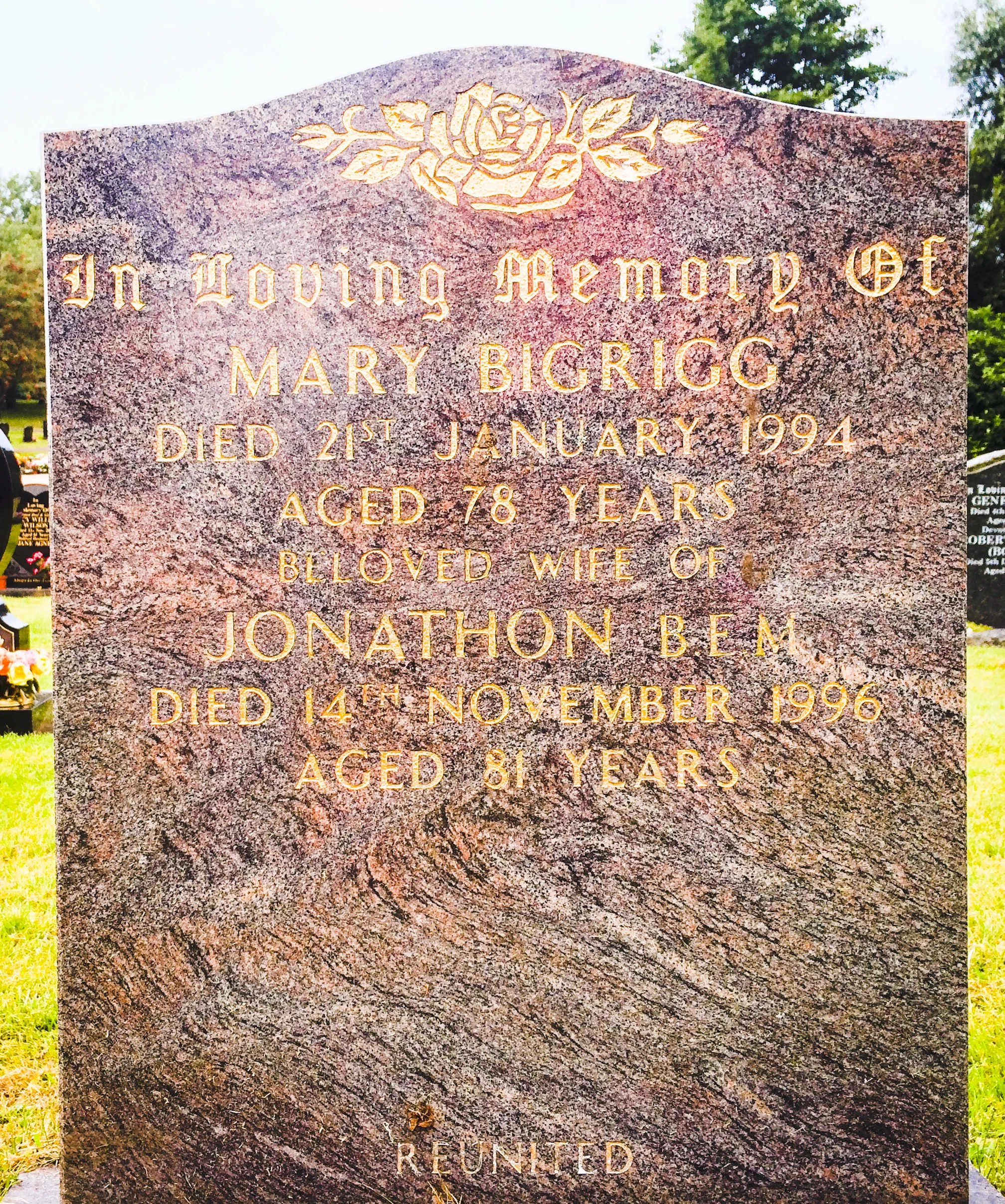
We called in at Egremont cemetery on our way past, not something we do that often, although we often shout ‘hello!’ over the cemetery wall in case Nana and Granda are listening out for us. Bizarrely, it’s twenty years since we buried my Granda Jon here, next to my Nana Mary who’d died two years previously. Twenty Years is a lifetime in itself. I’m not sure what they’d make of me now. At least I don’t have long hair any more. “Unnatural”, Nana used to say. When I tied it up in a ponytail to avoid her scorn, it was, “tidy. But unnatural.” I don’t have any hair any more.
Egremont isn’t Ennerdale, but you can see it from Castle Croft and Orgill, where Mary and her sister Janie finished their days. Or if you can’t quite see it, you know it’s there. Mary and Janie’s journeys took them down the valley to the nearest town, where they pretty much stayed. Every corner of every street contains a part of them - the cut-through to the Red Gra, the Cons Club, the bank - they were as much the town as the town was them.
Cycling back up Ennerdale, we stopped at the churchyard where Janie and ‘Mother’ Pearson are buried, past the tiny school where they all went as children, come rain or shine. As we pushed up the two miles from Ennerdale Bridge to Croasdale where the family lived back then, I thought about the long trudge for them to and from school each day, no bus to help them on their way. Coming up the hill beyond Wits’ End Cottage - my ancestral home, long-since sold into private hands rather than tenanted - I remembered Janie telling me about her weekly 10-mile slog on a pushbike with no gears from Croasdale to Turner How in Lorton where she was ‘in service’. Coming through Lamplugh back then meant avoiding the kids who’d come out and shout abuse - none of that these days.
My grandparents’ generation lived as quiet a life as they could by the time I met them - no surprises, nothing to further shake their souls beyond what two world wars had wrought upon them. Content to be content, lives contained by and held within as familiar and predictable a routine as could be hoped for. They planted their feet all over the rich earth around them, and told stories, shared jokes, sang songs to keep the darkness at bay. As a kid, I used to think that life here was slow, that nothing ever happened, that it was a long way from the bright lights, never realising that that was the point. I know that if I ever meet them again - in some half-waking dream, or a chance encounter between the worlds, we’ll look at each other and be full of a sort of aching pride: them for a future they could never have imagined; me for a past I could never have shared. This valley especially is full of my ancestors - I can barely turn a corner without bumping into them. To be honest, it’s probably one of the reasons I moved back here.
Mary, Janie and their sister Annie may all have shuffled off this mortal coil now, but each have descendants living no more than three miles from the cottage in Croasdale where they all grew up together. Today, we cycled past a signpost for the house that Annie’s daughter moved back to when she retired. We hurtled past Janie’s son’s cottage in the quiet hamlet down from The Leaps, where the only nuisance is the cyclists who come hurtling past. And then there’s me. All connected, all part of the same ever-unravelling story.
So, when I try to make sense of this whole ‘being human’ thing, I inevitably ask myself the question, ‘who am I?’, and I invariably think of all the people who came before me - characters in this story that started long before I was conceived. A long line of human beings each dreaming of a future they would never see. One of the things I am is a song-writer - I’ve written hundreds of songs, and I have hundreds more in the pipeline waiting for a breath or a spark to animate them - but really I only have one song to sing, and it’s the only song that any of us ever really sing. It’s the song that tells the story of where we came from and where we ended up. Being human is all about the bit in the middle.